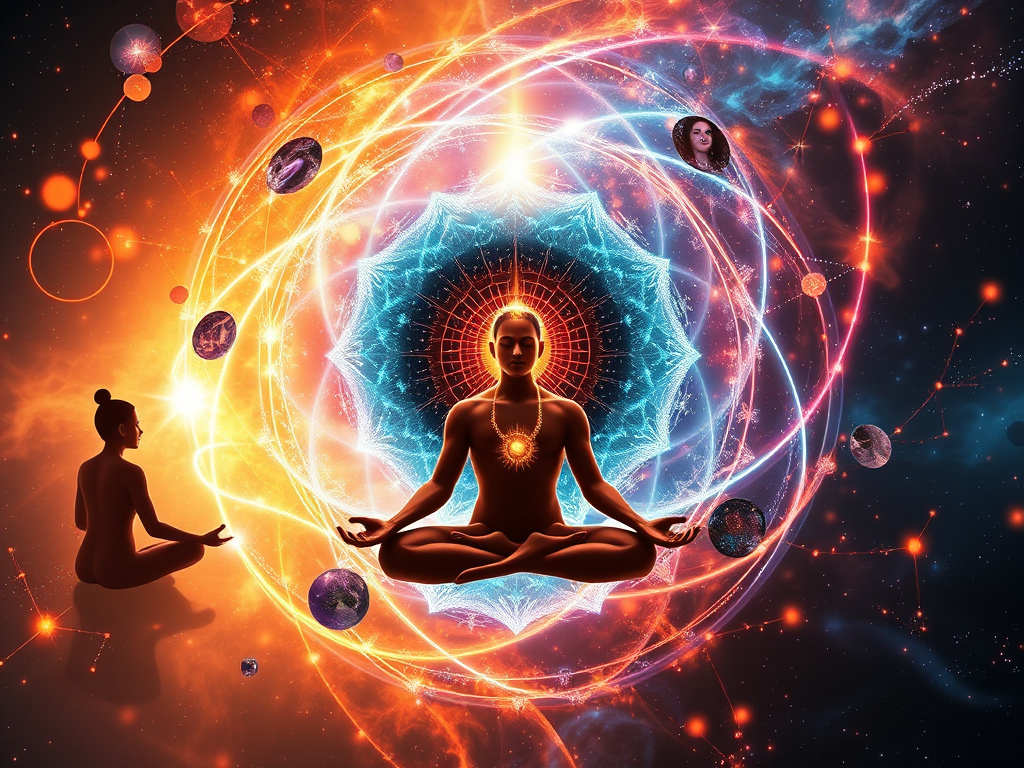
Modern science is catching up to something the sages of ancient India hinted at millennia ago — that reality is not singular, but manifold. That you are not a fixed being living in one timeline, but a dynamic awareness shifting through possibilities. That every decision, every thought, might open the door to another version of life.
This is not mere mysticism. It’s increasingly aligned with modern physics — and also with the writings of contemporary thinkers like Kevin L. Michel, who, in Moving Through Parallel Worlds to Achieve Your Dreams, proposes a bold idea: you are already moving through parallel realities. The key is to do it consciously.
Let’s begin with physics.
Quantum theory, particularly the Many-Worlds Interpretation, suggests that every quantum event — every moment where more than one outcome is possible — results in a branching of universes. In one, the coin lands heads. In another, it lands tails. In one, you quit your job. In another, you never even thought about it.
This isn’t fantasy. It’s a real attempt by physicists to explain why particles behave unpredictably — as both waves and particles, depending on how they’re observed. The act of observation seems to collapse possibility into one path, giving birth to the question: does consciousness shape reality?
Kevin L. Michel believes it does. In his book, he suggests that consciousness is not a passive observer, but an active tuner — capable of selecting from the vast spectrum of available universes. He argues that your beliefs, emotions, and habits determine your “vibrational alignment,” and you shift timelines accordingly. The version of yourself that’s successful, joyful, or healed? It already exists. You don’t create that version — you move toward it by becoming its match.
This idea — that consciousness steers you through multiple realities — might seem radical, until you recall that it has deep echoes in Hindu cosmology.
Let’s turn to the Puranas.
There is a remarkable story in the Bhagavata Purana, expanded in later texts like the Brahma Vaivarta Purana, in which Brahma, the creator of our universe, once visits Vishnu’s celestial abode, Vaikuntha.
Brahma enters with a question — proud, perhaps, of his unique role as the creator. At the entrance, Vishnu’s gatekeepers go to inform the Lord of the visitor.
But Vishnu calmly asks:
“Which Brahma?”
The gatekeepers are stunned. There’s only one Brahma, isn’t there?
Moments later, countless other Brahmas begin to arrive — each with different numbers of heads. One has ten. Another has a hundred. One even has a thousand. Each governs a different universe — a different creation — with its own laws, dimensions, and beings.
Our Brahma — the four-headed one — stands humbled as he realizes:
He is not the only creator, not even the greatest. There are infinite universes, each with its own Brahma, Vishnu, Shiva — each operating in its own version of reality.
This isn’t just poetic exaggeration. It is a cosmic declaration of the multiverse — told not with equations, but with avatars and symbols. And the message is clear: no reality is absolute. Even the gods exist in multiplicity.
Now bring this back to Kevin Michel’s work and to quantum theory. All three are saying:
Reality is not one thing. It is an ocean of probabilities.
And what you experience depends on your alignment — of energy, of thought, of intention.
In this way, Yogananda’s teachings offer the operating manual. Yogananda described the universe as composed of three interwoven realms:
- The Physical – the gross material world
- The Astral – the realm of energy, emotion, and subtle perception
- The Causal – the seed realm of pure idea, where intention becomes architecture
Through the practice of Kriya Yoga and deep meditation, Yogananda said we could rise from the physical into the astral, and from the astral into the causal — and in doing so, reshape the blueprint of our lives.
He wrote that a yogi, in deep samadhi, may experience other worlds, communicate with beings across dimensions, and even bring back knowledge or influence into this physical realm. That may sound mystical — but it aligns beautifully with what physicists suggest happens in the realm of quantum possibility, and with what Michel calls “intentional shifting.”
What does this all mean for the rest of us?
It means that you’re not stuck in the reality you see around you.
It means that each moment is not a dead end, but a portal.
And it means your awareness is the vehicle through which you choose where to go next.
In the lab, the observer affects the outcome.
In the mind, the meditator alters the vibrational field.
And in the scriptures, even gods travel across infinite versions of the cosmos.
Whether it’s a particle choosing a path, or Brahma discovering his multiversal peers, or you choosing a new belief, the thread is the same:
Reality is not fixed. It is fluid, and you are its shaper.
So next time you find yourself wishing for a better version of life, don’t just hope for change. Align with it. Think it. Act it. Meditate into it.
Because that life already exists — just one thought-shift away.


Leave a Reply