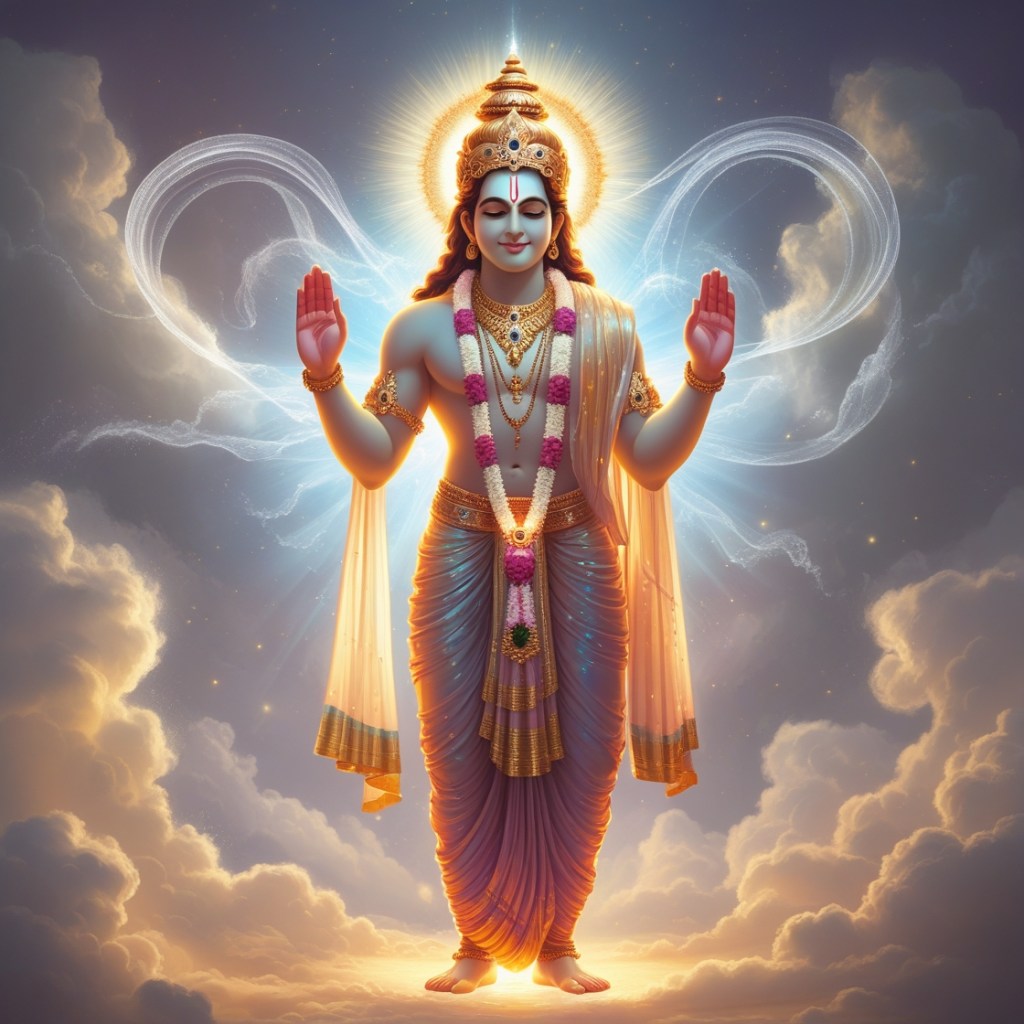
In the pages of the Brahmanda Purana, a powerful episode unfolds — one that reminds us that protection is not merely physical but deeply spiritual. Here, the text introduces the Trailokya Vijaya Kavacham — a “shield of victory over the three worlds.” What makes this kavacham unique is not just its poetic beauty but the intensity of its devotion, channeling every part of the body and every direction of existence into a prayer for protection by Krishna.
It is said that this kavacha was revealed from none other than Mahadeva himself, spoken for the benefit of seekers. To recite or wear it in spirit was to envelop oneself in Krishna’s presence, an armor stronger than any forged by human hands.
The Kavacham Retold in Devotion

May the sacred syllable Om guard my head,
and Krishna, eternal refuge, bless my brow.
May Govinda shine within my eyes,
Gopāla sing in the chambers of my ears,
and the sound of Hari rest upon my lips.
Let my tongue speak only His name,
let my throat flow with His praises,
and my shoulders be girded with His grace.
Mukunda shall guard my chest,
Vishnu fortify my arms,
and Narayana protect even the smallest of my nails.
Padmanabha dwells within my navel,
Madhava crowns my head with brilliance.
From waist to knees, from calves to steps,
let Yashoda’s joy and Vrinda’s beloved
stand as sentinels, preserving my way.
And beyond this body — in the vast expanse:
East and South, North and West,
in the corners, in the heights and depths,
on land, in water, and beneath the open sky —
let Krishna’s presence be my eternal armor.
Whether waking or resting,
whether in silence or in action,
let the soul of all souls,
the one beyond attachment,
be the shield that never fails.
This is the Trailokya Vijaya Kavacham —
the armor that brings victory across the three worlds.
The Promise of the Kavacham
The Purana does not shy away from magnifying its significance. This kavacham, it is said, bestows merits far beyond thousands of sacrifices and rituals. To embody it is to become like Vishnu himself. To carry it in devotion is to carry the very presence of the Lord. Speech (Saraswati) and Wealth (Lakshmi) accompany the one who holds it rightly. For such a seeker, liberation (jivanmukti) becomes a living reality.
It is a kavacham not merely of protection, but of transformation — clothing the seeker in divine consciousness.
Pondering the Mystery
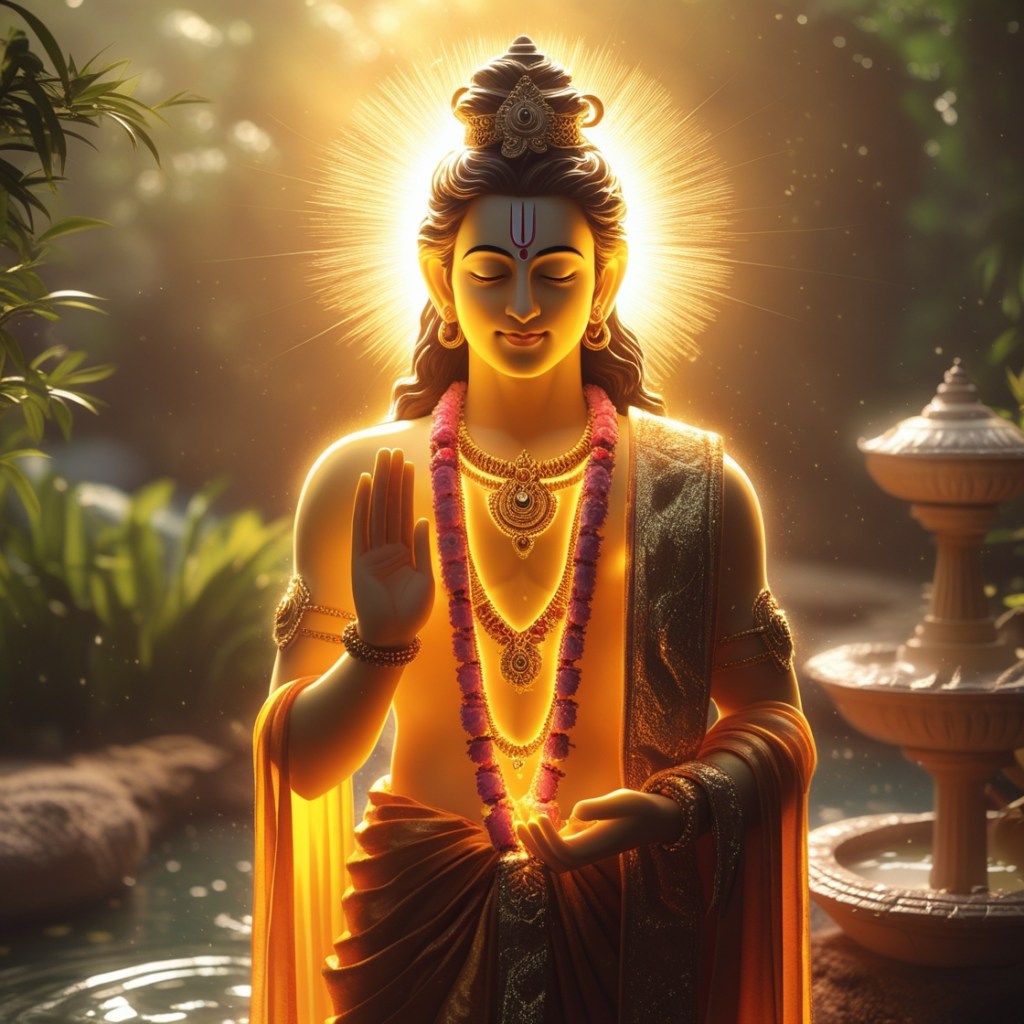
Yet, here arises a fascinating point of reflection. The kavacham is wholly dedicated to Krishna, and in these pages, He is invoked as the supreme reality. But Krishna, as we commonly think of Him, appeared later in the lineage of avatars. How, then, does a text connected to Parashurama’s time speak of Krishna’s kavacham?
This is no contradiction when seen in the broader philosophy of the Puranas. Krishna is not just the cowherd of Vrindavan or the prince of Dwaraka. He is spoken of as the timeless, supreme being, existing across all ages, all planes, and all worlds. The kavacham reminds us that while His earthly presence was bound to a particular yuga, His essence — as Vishnu, as Hari, as the eternal Paramatman — is unbound by time.
In the same section, Maruti (Hanuman) and Vibhishana are mentioned — figures of the Ramayana era, who, as chiranjeevis (immortals), continue to live across time. Perhaps this, too, is why they are woven into the narrative. In the Puranic vision, time is not linear. All beings exist within the divine tapestry simultaneously — past, present, and future mingling as one.
What It Means for Us Today
The kavacham is, at its heart, an invitation to reimagine protection. Today, we rely on walls, technology, wealth, or influence to shield us from harm. Yet, here we see a different kind of shield — one made not of iron or stone but of remembrance, surrender, and divine presence.
What if true protection lies not in what stands around us, but in what stands within us?
What if being clothed in Krishna’s name is not about superstition but about shaping one’s consciousness so deeply that fear, greed, and despair find no foothold?
In an age where anxieties stretch across every corner of life, the Trailokya Vijaya Kavacham whispers an old truth: that peace, courage, and freedom are found not in outer conquests but in inner alignment with the eternal.
A Disclaimer
This blog is based on translated passages from the Brahmanda Purana and reflects devotional and philosophical interpretations of those passages. It does not claim to represent the entirety of the kavacham or its ritual use, but seeks only to explore its spirit and ponder what such texts might mean for us in the present day.
 nakul sardesai
Leave a comment