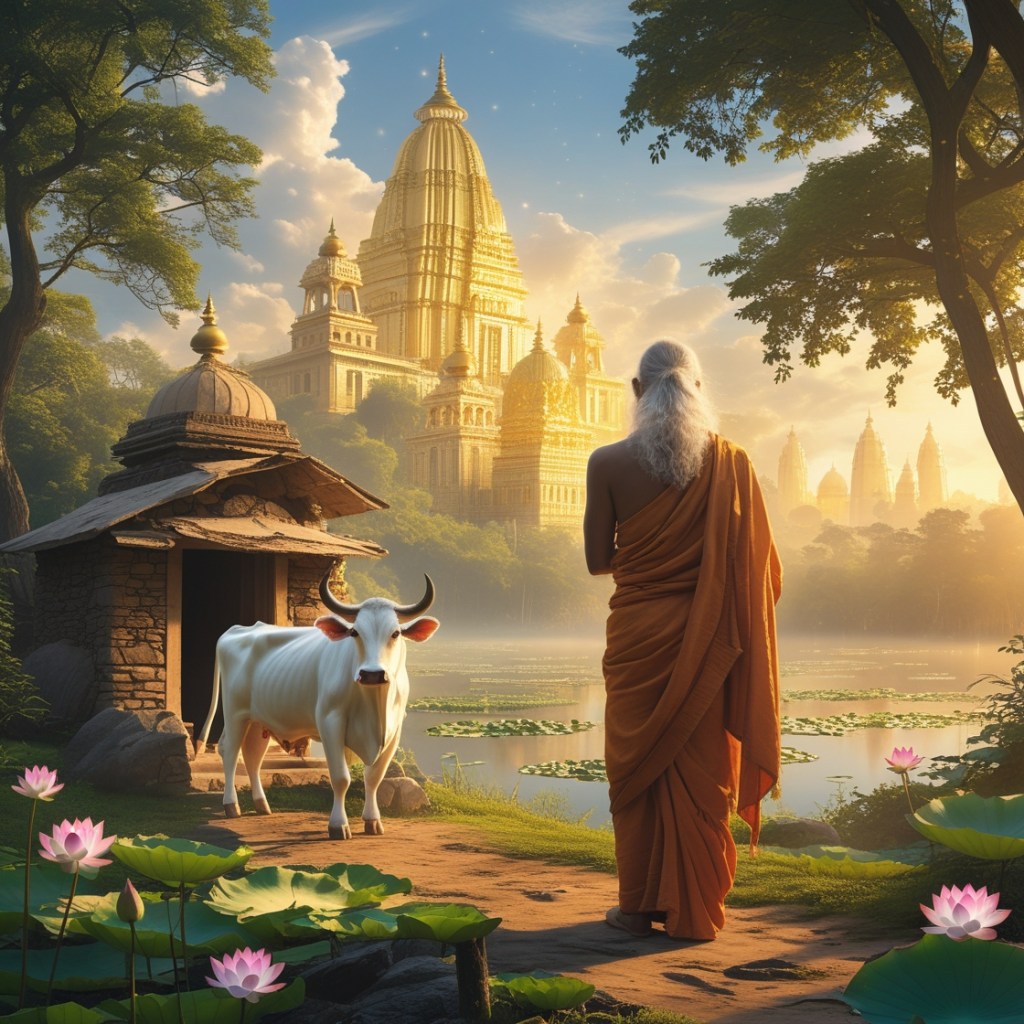
After a long day of hunting deep in the forest, King Kartavirya Arjuna, accompanied by his vast army, came upon the quiet hermitage of Rishi Jamadagni, father of the warrior-sage Parashurama.
The king, accustomed to the wealth of palaces and the scale of armies, was offered hospitality by the sage. He politely declined — not from arrogance, but from the practical thought that a hermit, living simply in the wilderness, could not possibly cater to such a large gathering.
Rishi Jamadagni only smiled, reassured him, and called upon his divine boon — a sacred cow, no ordinary creature, but one of cosmic origin. What followed is one of the most intriguing episodes in the Puranas, a scene where the line between miracle and metaphor seems to dissolve completely.
A City Born in an Instant

The cow did not merely produce food. In an act of effortless creation, she brought forth an entire city — complete and perfect in every detail.
Jewelled mansions rose into the sky, streets filled with skilled and gracious citizens, courtyards echoed with music, and lakes bloomed with lotuses. Groves heavy with fruits and flowers shaded avenues where deer roamed, and fragrant breezes carried the scents of sandalwood, blossoms, and pollen.
Courtesans, adorned like celestial goddesses, charmed the air with song and veena, their grace and beauty as intoxicating as their voices. Markets brimmed with treasures, pavilions shimmered with silks, and even the breeze seemed trained to delight. Every detail — from the ornaments to the laughter in the courtyards — spoke of a grandeur that was not built but revealed.
The Divinity of the Cow
In the Indian tradition, the cow is far more than livestock. She is a mother, a nourisher, and in certain divine forms, a cosmic force. Here she appears as Kamadhenu, the wish-fulfilling cow, capable of producing whatever is required — not just objects, but entire realities.
This manifestation was not wealth accumulated through trade or conquest, but a direct flowering of merit, dharma, and spiritual power. It was abundance as an extension of virtue.
How Could Such Grandeur Be Summoned So Seamlessly?
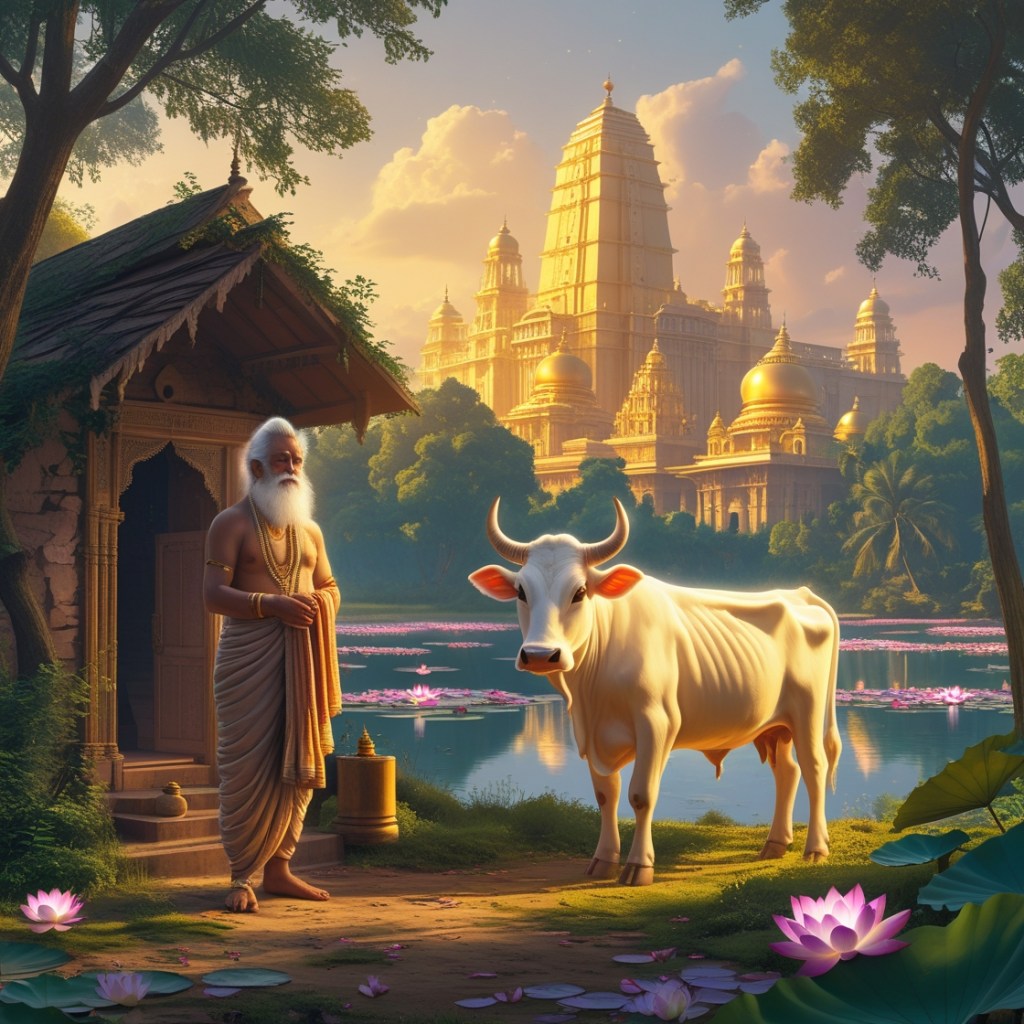
What is most striking here is the ease. There is no mention of preparation, labour, or time passing. One moment there is forest and hermitage, the next — a celestial metropolis, fully alive appears outside the hermitage keeping both the austere lifestyle and the newly summoned grandeur parallel to each other.
In yogic thought, such creation is possible when consciousness, will, and divine sanction align perfectly. The Rishi’s purity and merit acted as the current; the cow was the instrument. Reality itself bent to accommodate their union of intent.
The Mystery — Where Does It All Go?
If we take this literally, an inevitable question arises:
Where did the city and its countless inhabitants go after the king departed?
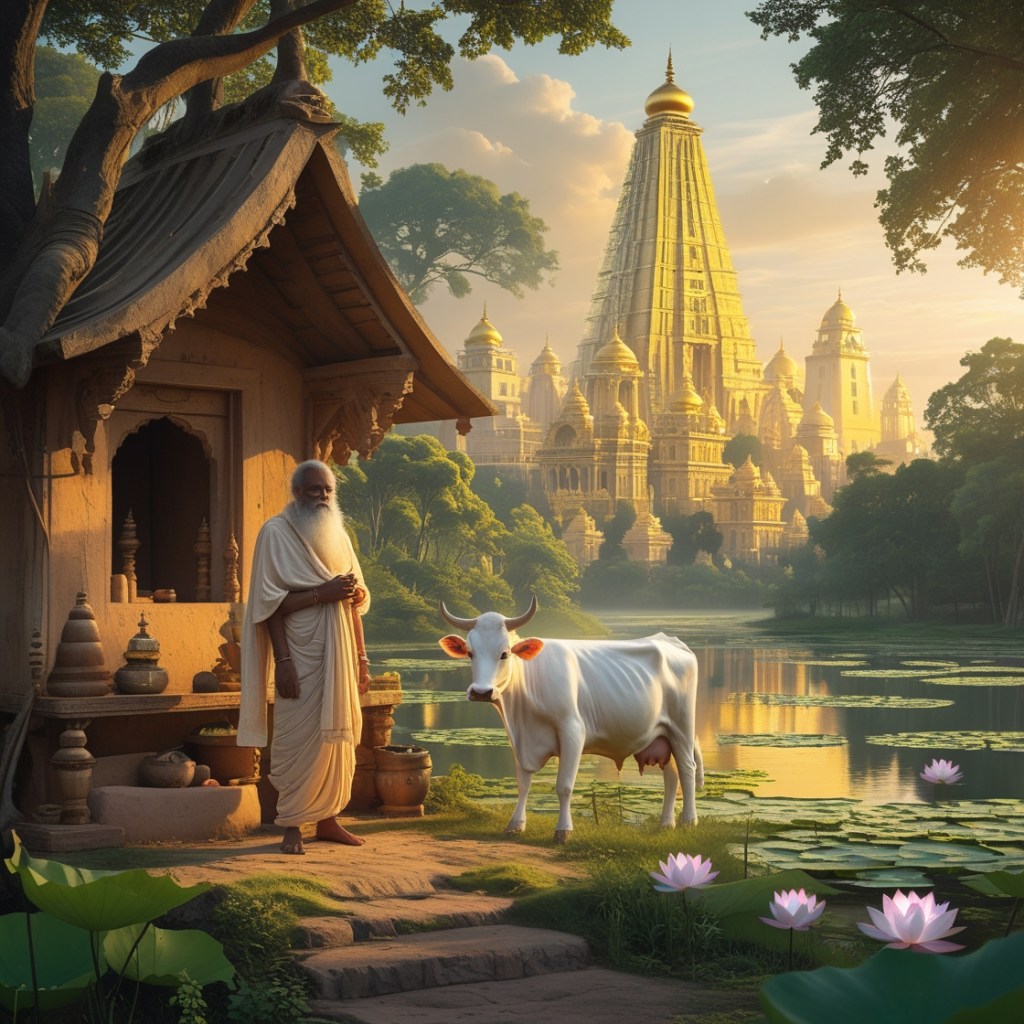
The Rishi did not move into the city; it was summoned — or perhaps created — outside the hermitage, solely for the purpose of hospitality. Once that purpose was fulfilled, it vanished. Did it return to some unseen realm, like Svarga or Go-loka? Were its people and buildings sustained only for those few hours, then dissolved back into divine potential?
Four Possible Explanations
- Divine Manifestation and Dissolution
The city was created from nothing, sustained by the cow’s divine energy, and dissolved back into the same source. The inhabitants and structures were temporary projections — fully real for the time they existed, but with no ongoing presence in the material world. - Drawing from a Parallel Realm
The cow could have acted as a bridge, pulling an existing city from a divine or parallel plane into visibility in our world. Once the purpose was complete, it returned to its original location, as effortlessly as it came. - Maya-Leela (Sacred Illusion)
The city may have been a conscious divine illusion — vivid, interactive, and capable of providing every experience, yet existing only in the minds and senses of those who beheld it. Once the king left, the illusion was withdrawn. - Metaphor for Inner Revelation
The “city” may be an allegory for the state of mind and spirit that the Rishi’s presence induced in the king — a temporary elevation into a realm of beauty, abundance, and order. When the visit ended, the “city” faded because it was an inner state, not an external place.
If All of This Is Metaphor…
Then perhaps:
- The cow represents the higher mind or spiritual faculty, which, when accessed, provides exactly what is needed.
- The city is the perfected state of consciousness — complete in beauty, order, and abundance.
- The courtesans are the senses, alluring but refined when serving a higher purpose.
- The king’s astonishment is our own awakening when we first encounter the abundance hidden within.
The Reality We Might Be Looking At
If literal, the episode suggests that ancient sages had access to forces or beings capable of instant manifestation — something beyond our present comprehension of material laws.
If metaphorical, it is no less extraordinary, pointing to the truth that when inner conditions are right, reality reshapes itself to reflect them.
Perhaps to the ancients, there was no hard line between the literal and the symbolic. A cow could be both a living divine entity and a teaching metaphor; a city could be both a heavenly domain and the inner landscape of an illumined mind.
The Lasting Lesson
Whether we read this as miracle or metaphor, one truth remains:
Abundance is not manufactured; it is revealed.
And when it is revealed through purity, discipline, and divine alignment, it arrives not in fragments, but as a whole and living reality — as complete as a city, as radiant as a heavenly court, summoned in a single breath of creation.
 nakul sardesai
Leave a comment