Introduction
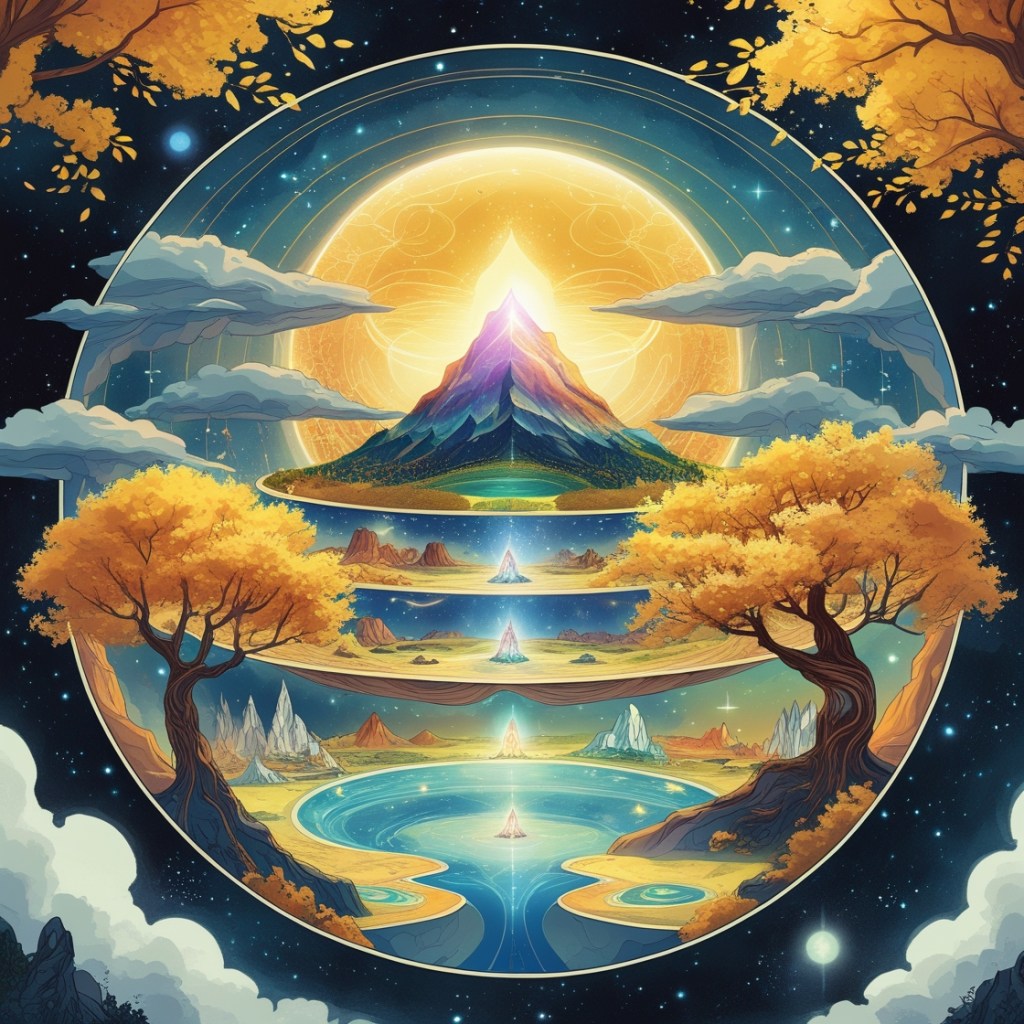
The Brahmanda Purana doesn’t describe the world the way we do. There are no continents as we know them, no national borders, and no familiar landmarks. Instead, we find vast lands like Jambu-dvipa, layered oceans, and mountain ranges taller than imagination. Each part of this world is filled with divine trees, radiant beings, and impossible lifespans.
So what does this mean for us today?
This blog attempts a simple exploration:
- What does the Brahmanda Purana say, word for word?
- How can we possibly understand this today—if not literally, then as a vision of something more layered, multidimensional, or symbolic?
Jambu-dvipa is large and beautiful… — Brahmanda Purana

“Jambu-dvipa is large and beautiful. In every direction, there are large circles. It is surrounded by nine worlds, and each of these has beings that have been created.”
This dvipa is said to be surrounded by an ocean of the same size, and is bordered by massive mountains and separate lands.
What could this mean for us today?
Maybe it’s not just describing Earth as we know it. What if Earth is just one realm among many, and these “circles” and “worlds” are actually other dimensions or planes of existence? Could the multiple worlds of modern quantum theory or multiverse speculation echo this model?
Meru is said to be round and white… its summit extends for thirty-two thousand yojanas.
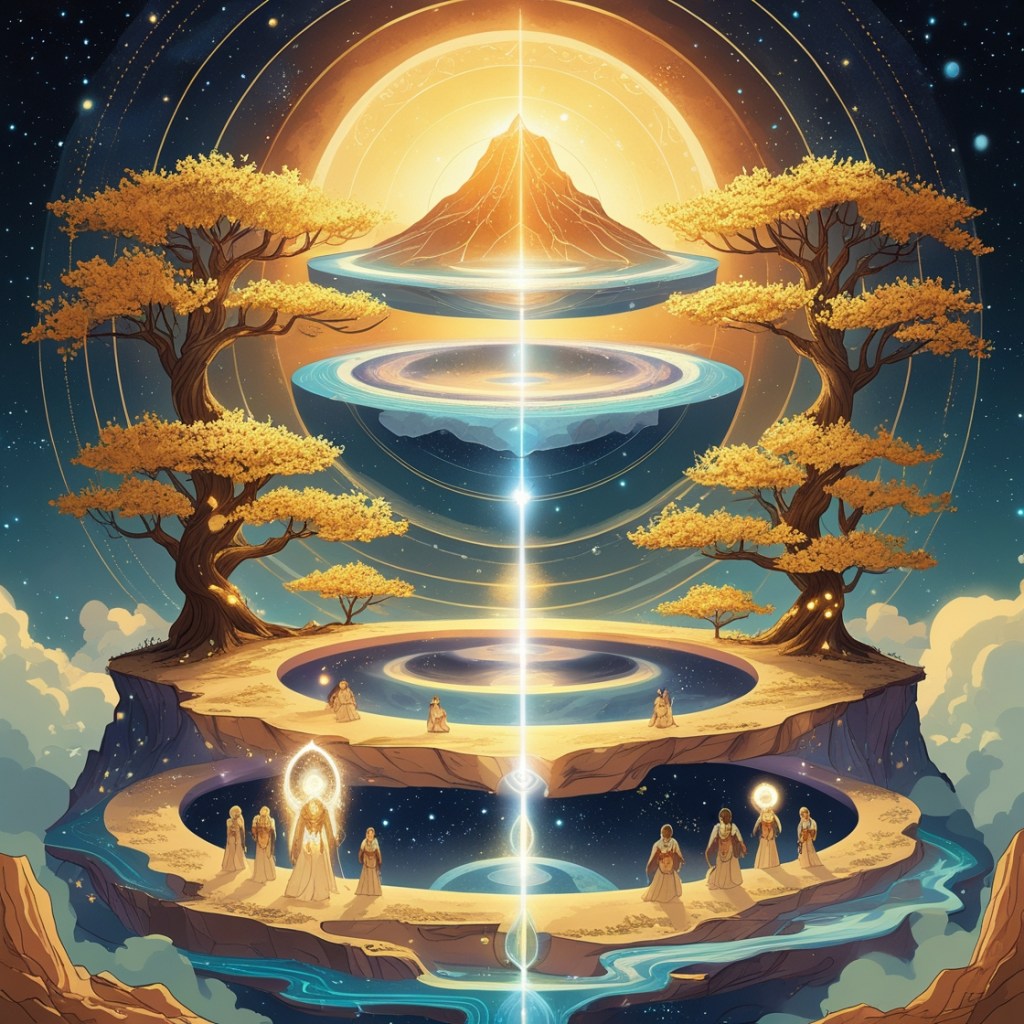
“Meru is said to be round and white. The summit extends for thirty-two thousand yojanas. It is of square shape and lofty on four sides.”
Mount Meru is at the center of Jambu-dvipa and is described in great detail.
What could this mean for us today?
Meru doesn’t seem to be a mountain in the usual sense. It could represent the central axis of consciousness—a spiritual spine. The four-colored sides (white, red, yellow, black) are said to reflect the four varnas (castes). Could this mountain be a symbolic structure, rather than a physical one?
Each of the six varsa-parvatas… is one hundred thousand yojanas in length and height.
“Each of the six varsa-parvatas that exist in the varsas is one hundred thousand yojanas in length and height.”
These massive mountains separate the various regions or “varsas.”
What could this mean for us today?
Maybe these mountains represent barriers between states of consciousness, or even between parallel realities. Instead of physical obstacles, they could be dimensional borders that one crosses through yogic awareness, death, or deep meditation.
4. In these lands, people live long lives… they do not suffer from aging, delusion, or death.
“Inhabitants of these regions live blissful, disease-free lives—drinking from special trees, consuming ambrosial food, and experiencing great vitality.”
In some varsas, people are born as twins, live for thousands of years, and never feel sorrow or aging.
What could this mean for us today?
What if these are descriptions of alternate planes where beings live with fewer limitations? In today’s terms, this could be interpreted as a higher vibrational state or realm—something like what near-death experiences, yogic samadhi, or spiritual visions describe.
Or maybe these are idealized reflections of how human life could be under different cosmic conditions.
There are trees that drip milk, trees that grant youth and joy…

“Descriptions of Nyagrodha (banyan) trees, milk-exuding trees, and Kalamra (black mango) trees that give eternal youth or joy through their fruit.”
These aren’t ordinary trees. They nourish the soul, not just the body.
What could this mean for us today?
This might be coded language for deeper forms of nourishment—perhaps experiences, energies, or even mantras that rejuvenate the spirit. Or it could be literal, in the sense that in different realms, life forms and food sources behave differently.
Modern science already explores how sound affects water and light affects cells. Could these trees represent energetic ecosystems in higher realities?
Possessing Prajapati’s qualities, Meru arose from the mind of Brahma…
“On the east, it is white in color, reflecting the nature of being a brahmana….”
Each direction of Meru has a color and a symbolic meaning.
What could this mean for us today?
This could be a spiritual mandala, with each direction representing a quality or path of consciousness. Maybe these aren’t racial or caste markers, but symbolic of roles within creation—each equally vital.
Conclusion: If Not Earth, Then What?
If we stop asking “Where is this place?” and start asking “What is this trying to describe?”, a new view opens up.
- Maybe the Brahmanda Purana is describing layers of reality, not lands.
- Maybe the enormous distances represent expanses of experience, not space.
- Maybe Earth is just one of many nested dimensions, and these dvipas are the names of those surrounding worlds.
The sages didn’t measure reality with satellites. They mapped it with symbols, sounds, and silence.
So when they say, “Jambu-dvipa is large and beautiful”, maybe they are telling us something much deeper:
That reality itself is layered, alive, and far more mysterious than we dare to imagine.

 nakul sardesai
Leave a comment