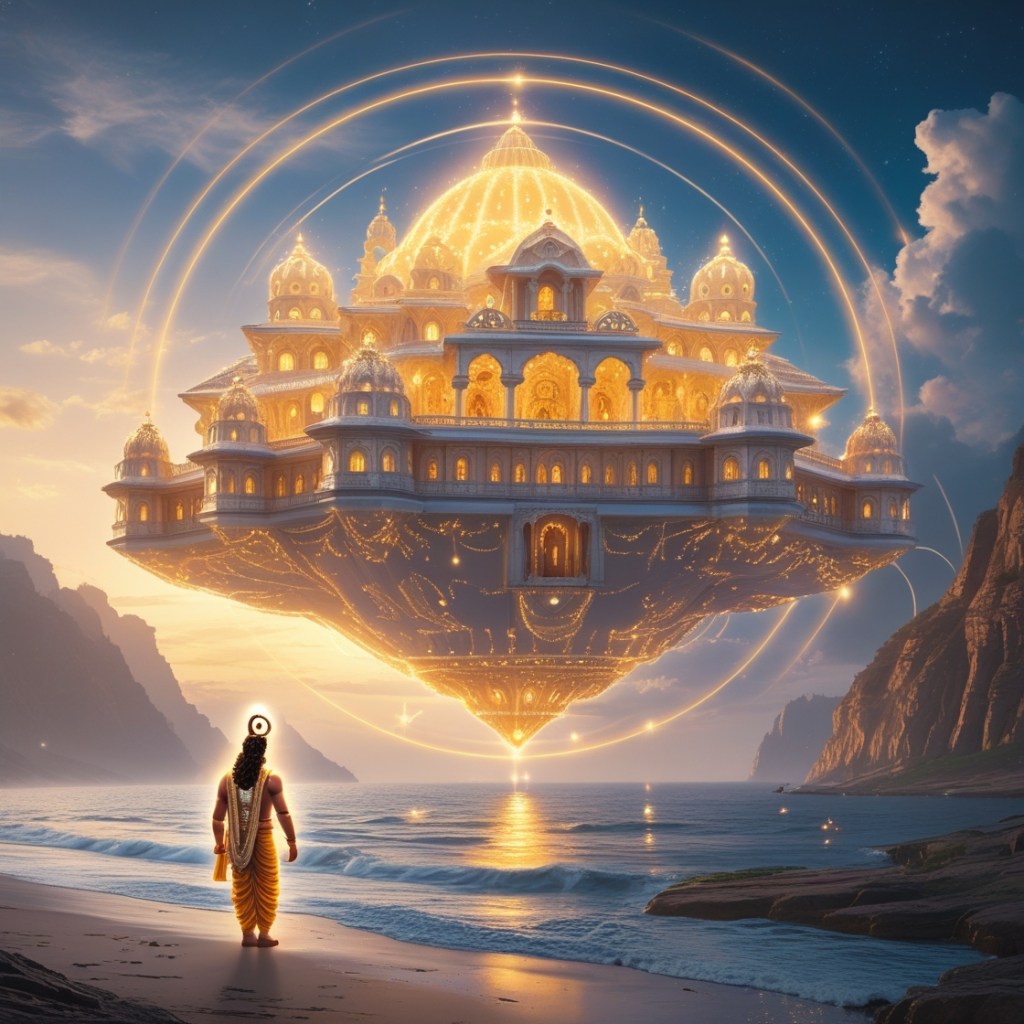
Introduction — A Palace That Travels Without Moving
In the Vishnu Purana, there’s a moment that feels almost like science fiction—Lord Krishna, after building the grand city of Dwaraka, wishes to bring a magnificent celestial hall called Sudharman from the heavens down to Earth. But instead of having it built, he simply asks for it, and with the help of Vāyu, the Wind God, the hall magically appears in his city, complete in all its glory.
To many, this sounds like myth or fantasy. But what if this story is trying to describe something deeper—something about how spaces can be shaped or summoned through intention, energy, or consciousness?
Instead of physically moving the palace, it’s as if Krishna tunes the space of Dwaraka so perfectly that the celestial hall can exist there, almost like receiving a signal on the right frequency. It’s not about bricks or beams—it’s about aligning energy to receive something that already exists.
In this blog, we’ll explore the idea that Sudharman wasn’t just a story of divine luxury, but perhaps an ancient way of describing how space, sound, and consciousness work together to create sacred structures—even realities.
The Story of Sudharman — A Gift from the Gods

The story of Sudharman begins in the golden city of Dwaraka, built by Krishna as a safe haven for the Yadava clan. After the city is established, Krishna desires to bring even more of the divine to Earth—specifically, the grand assembly hall of the gods, known as Sudharman, which resides in Indra’s celestial realm.
Instead of building a replica, Krishna sends Garuda and Vāyu—the eagle mount and the wind god—to request the hall itself from Indra. Surprisingly, Indra agrees. But the fascinating part is what follows: Vāyu brings the hall to Dwaraka not by lifting or carrying it, but through means that aren’t described in physical terms. The hall appears in Dwaraka, completely intact, as if it were always meant to be there.
No bricks were laid. No laborers toiled. The structure didn’t travel by chariot or sky ship. It simply arrived, guided by divine forces and perhaps something even subtler—a readiness of space, a harmony between the realms that allowed Sudharman to exist in Dwaraka just as it did in heaven.
This tale invites us to consider: Is this just myth? Or could it be a symbolic way of saying that some structures don’t need to be built—they need to be invoked?
The Science Behind the Story — Could This Really Happen?

At first glance, the idea of a hall just appearing from the heavens sounds like pure fantasy. But when we look at this story through the lens of modern science—especially fringe or theoretical physics—it begins to sound surprisingly possible.
Let’s consider a few scientific ideas that might offer an explanation:
1. Quantum Teleportation
In quantum physics, scientists have already demonstrated a process called quantum teleportation. This doesn’t mean moving physical objects through space like in science fiction movies, but rather transferring the exact information or state of one particle to another, instantly, at a distance. In theory, if a structure could be completely encoded as information, it might be “reassembled” elsewhere without physically moving it.
2. Non-Locality and Instantaneous Communication
Quantum entanglement shows that particles can be linked across vast distances—what happens to one instantly affects the other. In the story, Sudharman may not have been “moved” at all. Perhaps it was always present on some level, and Krishna simply aligned Dwaraka to receive it, much like tuning into a frequency on a radio.
3. Energy Fields and Resonant Architecture
Some theories in alternative science propose that energy fields or vibrations can hold the blueprint of physical forms. If Dwaraka had the right energy conditions, the structure of Sudharman may have simply “materialized” in harmony with its vibrational signature—a kind of energetic download.
4. Consciousness as a Creative Force
Many ancient traditions suggest that consciousness itself can shape reality. In the Sudharman story, Krishna’s desire, intention, and spiritual power may have served as the trigger to manifest a divine space from a higher plane. This matches modern discussions in consciousness science, which consider the mind not just a passive observer, but a potential participant in shaping the world.
This isn’t to say the story of Sudharman is “proven” by science—but it’s worth asking: Were the ancients pointing to truths about space, energy, and consciousness we’re only now beginning to explore?
Sacred Architecture and Vibrational Design

In many ancient cultures—especially in India—architecture wasn’t just about bricks, wood, or aesthetics. It was about energy, direction, proportion, and resonance. Temples, palaces, and sacred halls were built as instruments, not just shelters. They were designed to hold and transmit specific energies.
The story of Sudharman aligns with this deeper understanding of space as sacred and form as frequency.
Vastu Shastra: Tuning the Earth
In Indian tradition, Vastu Shastra is the science of spatial energy—how buildings interact with the Earth’s magnetic fields, sunlight, wind, and cosmic energies. It’s said that a space built with the right proportions and intentions becomes more than physical—it becomes alive.
Sudharman, then, may not have been “brought” to Earth, but called into presence by Krishna creating the right conditions. It’s as if Dwaraka itself was tuned like a musical instrument, and when the frequency matched, Sudharman could manifest.
Prana Pratistha: Awakening Spaces with Intention
In sacred rituals, a temple or statue isn’t considered active until it’s “brought to life” through prāṇa pratiṣṭhā—a ceremony involving sound (mantra), focus, breath, and ritual movement. This is a process of installing energy into a form.
Could Sudharman have undergone something similar—an energetic transmission from one space to another, activated by Krishna’s intent?
Sacred Geometry and Resonance
Many temples, mandalas, and yantras are designed with precise geometric ratios—said to channel and stabilize energy. Modern experiments in cymatics (sound shaping matter) show that sound frequencies can create symmetrical, complex patterns in sand, water, or metal.
It’s possible that Sudharman’s form itself was a vibrational geometry—a pattern of sacred ratios that naturally exists across dimensions, and only needed the right energetic gateway to appear.
Sudharman may not have been “transported” like an object. Instead, it could have been received, much like a sacred signal, activated through intention, vibration, and space alignment.
Final Reflections — A Palace Called by Consciousness
The story of Sudharman challenges how we think about space, matter, and creation. In modern terms, it reads less like a myth and more like a symbolic instruction—suggesting that what we call “building” may sometimes be “revealing”.
Instead of effort, tools, and materials, Krishna used intention, alignment, and clarity of consciousness. He didn’t command Sudharman to be constructed—he invited it. And the universe responded.
This invites a deeper question:
What else in life can be received rather than built—when our energy is in the right state?,
In ancient traditions, space wasn’t passive. It was seen as intelligent and responsive. Architecture was an act of dialogue with the cosmos. Perhaps the tale of Sudharman isn’t just about a palace—it’s about the possibility that form follows vibration, and that consciousness can shape even the world around us.
In a time when we’re beginning to rediscover the power of sound, geometry, and intention, maybe this ancient story was always meant to be more than myth.
Maybe it was a message—to tune our spaces, our minds, and our frequencies—so we too can call in what feels distant… and make it real.
 nakul sardesai
Leave a comment