
Time as a Bridge Between Science and Scripture
Time is not just a ticking clock or a linear progression from past to future. In the deepest layers of both scientific thought and spiritual literature, time is an expansive, multi-dimensional force. While modern cosmology defines time using space-time coordinates, quantum uncertainties, and thermodynamic arrows, ancient Hindu scriptures like the Puranas, Upanishads, and epics such as the Ramayana and Mahabharata offer a more fluid, metaphysical experience of time.
This blog post seeks to delve into the intricate structure of time as laid out in the Puranas, particularly focusing on Kalpas, Yugas, and cross-epoch interactions. Through elaborate stories like the divine visit of Devi Parvati across Yugas, Kakbhusundi witnessing multiple Ramayanas, and Bhagwan Parashurama’s presence in both the Ramayana and Mahabharata—this essay draws compelling parallels with scientific concepts like time dilation, parallel universes, and cosmological cycles.
The Architecture of Time in the Puranas: Kalpa, Yuga, and Beyond

In Hindu cosmology, time is cyclical, expansive, and layered. It is divided into four major units:
- Yuga: The smallest unit in this cosmic scale.
- Mahayuga: A cycle of the four Yugas—Satya, Treta, Dvapara, and Kali.
- Manvantara: 71 Mahayugas make up a Manvantara.
- Kalpa: 14 Manvantaras make up one day of Brahma—this is called a Kalpa.
A full day of Brahma (Kalpa) equals 4.32 billion human years, the same length as his night. A full day-night cycle thus spans 8.64 billion years. This is repeated over Brahma’s lifespan of 100 divine years, or 311.04 trillion human years.
This mind-bending scale may seem mythical, but it aligns surprisingly well with modern cosmological estimates:
- Age of the Earth: ~4.5 billion years
- Age of the Universe: ~13.8 billion years
- Projected life of the Sun: ~10 billion years
- Ultimate fate of the universe: estimated in trillions of years depending on the model
While science measures time in scalar values, the Puranas assign quality and energy to each age. For example, Satya Yuga is marked by virtue and longevity, while Kali Yuga is marked by moral decline and spiritual ignorance.
Time Travel and Dimensional Leaps in Puranic Narratives
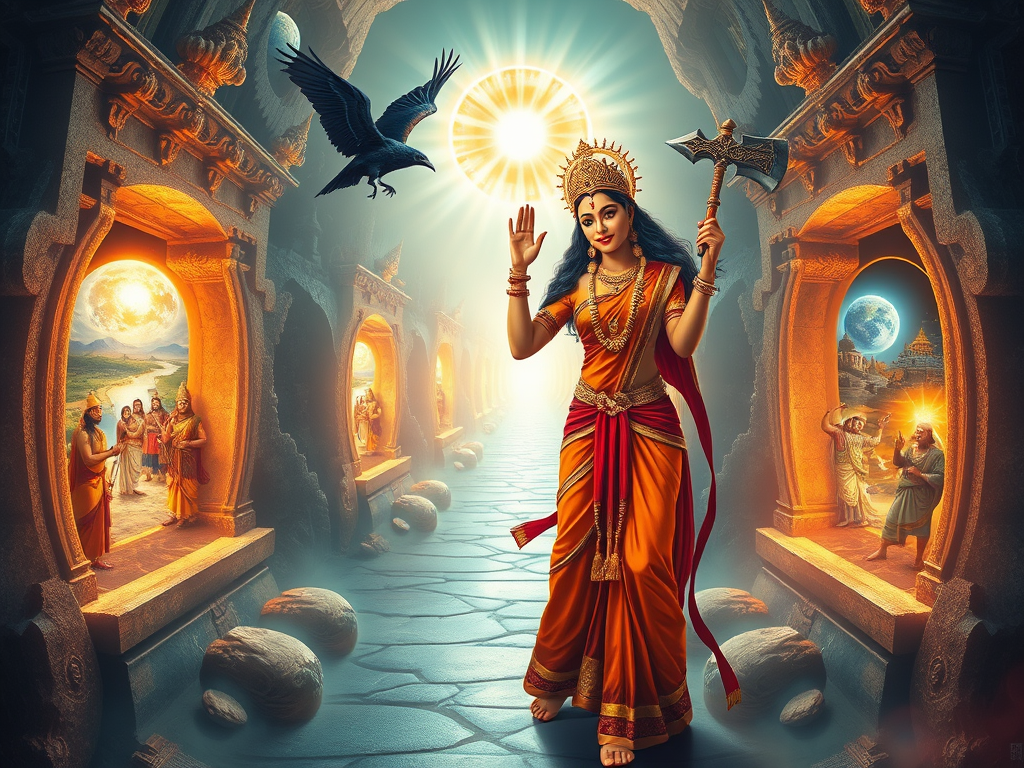
The Puranas and epics are replete with narratives that challenge the linear flow of time. Here are a few striking examples:
A. Devi Parvati’s Journey to Witness Bhagwan Rama
According to the Adhyatma Ramayana and certain Puranic retellings, Goddess Parvati, who exists in Satya Yuga alongside Lord Shiva, expresses a desire to witness Lord Rama in Treta Yuga. Shiva tells her that Rama has not yet incarnated in their current time, but he eventually allows her to transcend time to see the events of Ramayana unfold.
This journey is not symbolic—it is treated as a factual crossing from one Yuga to another. She observes Rama and Sita during their forest exile and is so overwhelmed by Rama’s divinity that she later admits she failed to recognize his true nature at first glance.
Scientific Parallel: This mirrors the concept of time dilation and alternate frames of reference. In Einstein’s relativity, an entity moving at a different speed or gravitational field may experience time differently. The idea of crossing dimensions into a different “time layer” also resonates with theories of multiverse interaction and brane cosmology.
B. Kakbhusundi: Witness of Infinite Ramayanas
Sage Kakbhusundi, originally cursed into the form of a crow, is said to have achieved such spiritual evolution that he gained the power to observe the Ramayana repeating eternally in countless universes. He claims to have seen not just one but many versions of Rama, each with slightly different characteristics, actions, or outcomes.
He resides in a sacred state, consciously choosing which version of the story to enter or exit.
Scientific Parallel: This story aligns with the Many-Worlds Interpretation (MWI) of quantum mechanics, which postulates that all possible outcomes of a quantum decision happen in separate, branching universes. Kakbhusundi’s journey is essentially the traversal of alternate realities—much like navigating a multiverse.
C. Parashurama: The Avatar that Spans Yugas
Bhagwan Parashurama is the sixth avatar of Shri Vishnu, born in Treta Yuga. Unlike other avatars who appear only during their designated era, Bhagwan Parashurama remains active through multiple Yugas. He first appears in Treta, where he confronts kings and clears the earth of corrupt rulers 21 times. He also confronts Bhagwan Rama (the seventh avatar) during Sita’s swayamvara, recognizing Bhagwan Rama’s divinity after their encounter.
Later, he appears in the Mahabharata, a story set in Dvapara Yuga, where he serves as a mentor to Bhishma, Karna, and Drona. The narrative treats Bhagwan Parashurama not as a memory or deity but as a living participant across Yugas.
Scientific Parallel: Parashurama’s timeline bending parallels the idea of an entity immune to entropy and linear decay—a being existing in a higher-dimensional reality. In string theory and higher-dimensional models, certain objects (branes, strings) can transcend lower-dimensional limits. Parashurama, then, could be viewed as a 5D being operating in a 4D world.
Overlapping Avatars and Cosmic Recurrence
Hindu cosmology does not subscribe to the idea of a single historical timeline. Instead, it presents a cyclical view of time where even divine avatars manifest repeatedly across Kalpas and Yugas.
A. Avatar Repetition Across Kalpas
In texts like the Vishnu Purana and Bhagavata Purana, the ten avatars of Bhagwan Vishnu (Dashavatara) do not occur just once in history but manifest in every cycle. For instance, in each Kalpa, Bhagwan Rama, Bhagwan Krishna, and even a Bhagwan Narasimha appear. While each manifestation may differ slightly, the cosmic function and archetype remain constant. This implies a cosmic recurrence—a script of divine evolution replayed with subtle variations across the ages.
B. Bhagwan Parashurama as a Timeline Bridging Avatar
Unlike Bhagwan Rama and Krishna, who are central to their respective Yugas, Bhagwan Parashurama is transitional. His continued presence through Treta, Dvapara, and possibly Kali Yuga suggests he exists outside the conventional constraints of time. He is said to still reside at Mahendragiri mountain, meditating and awaiting the end of the current era to return as a teacher for Kalki, the final avatar.
This makes him a chronological anomaly—a divine being whose consciousness and presence transcend the typical Yuga boundaries.
C. Bhishma and Time Knowledge
Even mortal characters like Bhishma exhibit a profound understanding of time. His ability to choose the moment of his death (Ichha-mrityu) indicates not just mastery over mortality, but also a heightened alignment with cosmic rhythms—something that modern physics might call quantum entanglement with the universe’s temporal field.
Scientific Parallels and Theoretical Resonance
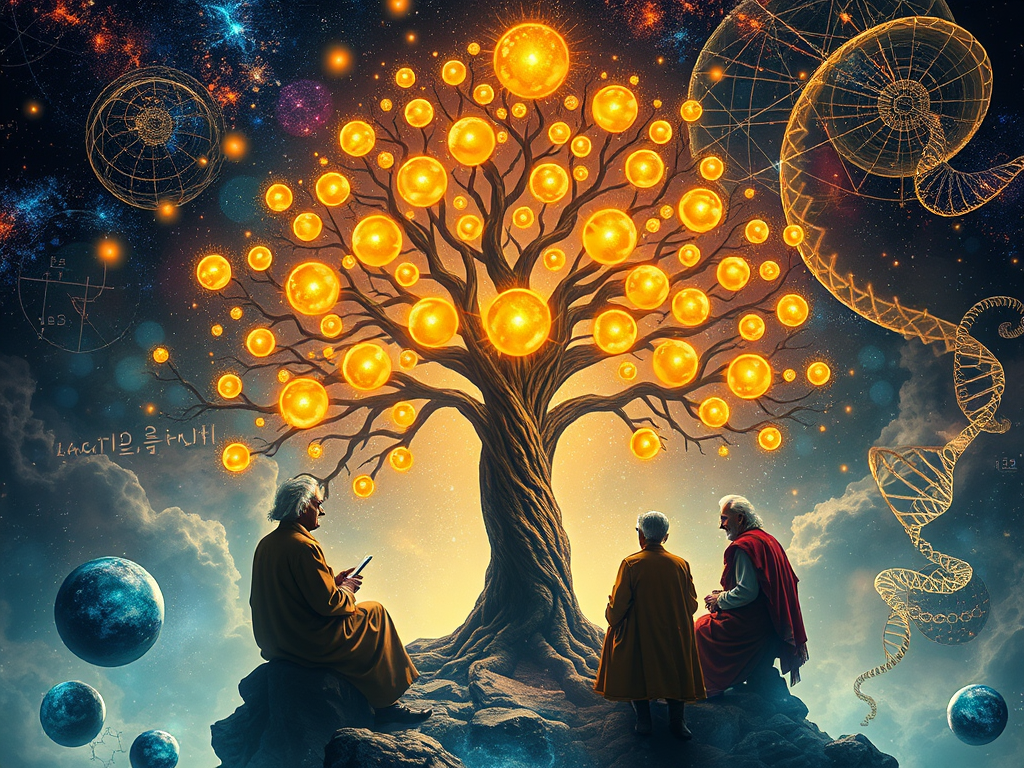
While Hindu scriptures describe time through metaphor and story, modern science approaches it with instruments and equations. Yet the parallels are unmistakable:
A. Time Dilation and Relative Time
Einstein’s Theory of Relativity tells us that time moves differently for observers depending on speed and gravity. This is akin to how time in Deva Lokas (heavenly realms) is experienced differently from Earth. A single day in Svarga Loka is equivalent to years on Earth—a concept echoed in the Mahabharata when heroes visit Indra’s court.
B. Many-Worlds and Quantum Possibility
The Many-Worlds Interpretation (MWI) suggests that all possible outcomes occur in branching realities. This is directly reflected in Kakbhusundi’s vision of countless Ramayanas playing out across dimensions—each unique yet true.
C. Cyclical Time and Cosmological Models
Modern cosmology explores models like Conformal Cyclic Cosmology (CCC) and the Oscillating Universe Theory, which propose that the universe undergoes endless cycles of expansion and contraction. This mirrors the Puranic model of Kalpa (creation), Pralaya (destruction), and re-creation.
Integrative Analysis: Science and Spirituality Meet at the Horizon of Time
While Puranic time is embedded in devotion and divine play (Lila), and scientific time is bound by thermodynamic laws and relativistic math, both systems point to a truth beyond linearity. They suggest that time is not a flat line but a dynamic, elastic medium shaped by the observer’s position, purpose, and awareness.
In Hindu thought, sages and avatars are time-travelers not by machine but by consciousness. In science, advanced theories increasingly admit that consciousness itself may be entangled with the structure of reality, suggesting that observer and observed are not separate.
Thus, time—once considered a wall separating past from future—becomes a mirror in both systems. What lies beyond that mirror may be where science and spirituality converge.
The Eternal Dance of Time
The Puranas offer not just stories, but maps of time, codes of consciousness, and models of reality that resonate with modern physics in astonishing ways. From Kalpas to quantum fields, from avatars to oscillating universes, the parallels are too profound to ignore.
In this dance of time—where Devi Parvati crosses Yugas, Kakbhusundi watches multiple realities, and Bhagwan Parashurama walks through epochs—we find ourselves invited not just to believe, but to wonder.
Science seeks answers; spirituality seeks meaning. Between the two lies the timeless truth: that reality is vast, mysterious, and ever-unfolding—and that perhaps, time itself is the greatest mystery of all.
 nakul sardesai
Leave a comment